Taking KUVAN
How to Take KUVAN® (sapropterin dihydrochloride) Tablets or Powder
- Once a day
- At the same time each day
- With food, preferably your largest meal of the day
Take KUVAN Tablets or Powder for Oral Solution exactly as your doctor tells you.
Please see KUVAN Instructions for Use.
Taking KUVAN Powder 500 mg Is as Easy as 1-2-3
KUVAN Powder dissolves completely in 15 seconds in water, apple juice, or a small amount of soft food such as applesauce or pudding.
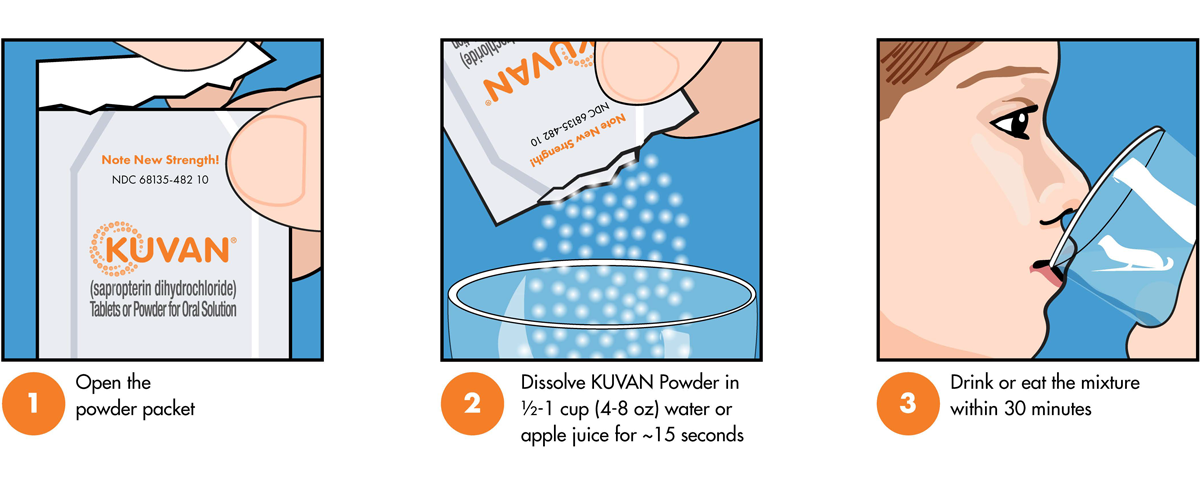
Keep in Mind
- Follow your doctor’s directions for taking KUVAN Tablets and Powder
- If you forget to take your dose of KUVAN, take it as soon as you remember that day. If you miss a day, do not double your dose the next day—just skip the missed dose. If you take too much KUVAN, call your doctor for advice
- KUVAN should be taken every day in conjunction with a low-Phe diet. Don’t change your diet without talking to your doctor or dietitian
What is KUVAN?
KUVAN® (sapropterin dihydrochloride) Tablets for Oral Use and Powder for Oral Solution are prescription medicines used to lower blood Phe levels in adults and children over one month of age with a certain type of Phenylketonuria (PKU). KUVAN is to be used along with a Phe-restricted diet.
What is the most important information I should know about KUVAN?
KUVAN can cause serious side effects, including:
- Severe allergic reactions including anaphylaxis. Stop taking KUVAN and get medical help right away if you develop any of these signs or symptoms of a severe allergic reaction:
- Inflammation of the lining of the esophagus or stomach (esophagitis and gastritis). Your doctor will monitor you for symptoms of inflammation in your upper gastrointestinal tract, including your stomach and esophagus. If untreated that inflammation can lead to serious side effects including narrowing of the esophagus, ulcers, and bleeding. Call your doctor right away if you have any of these signs or symptoms:
- Phe levels that are too low. Patients have experienced low blood Phe during treatment with KUVAN. Low blood phe is more common in children under the age of 7 who take high doses of KUVAN each day.
- Too much or constant activity (hyperactivity) can happen with KUVAN. Tell your doctor if you have any signs of hyperactivity, including:
What should I tell my doctor before I take KUVAN?
Before you take KUVAN, tell your doctor about all your medical conditions, including if you:
- Are allergic to sapropterin dihydrochloride or any of the ingredients in KUVAN
- Have poor nutrition or have a loss of appetite
- Are pregnant or plan to become pregnant
- Are breastfeeding or plan to breastfeed. It is not known if KUVAN passes into your breast milk. Talk to your doctor about the best way to feed your baby if you take KUVAN.
Tell your doctor about all the medicines you take, including prescription and over-the-counter medicines, vitamins, and herbal and dietary supplements. KUVAN and other medicines may interact with each other. Especially tell your doctor if you take:
- A medicine that contains levodopa
- An antifolate medicine such as methotrexate, valproic acid, phenobarbital, trimethoprim
- Sildenafil (Revatio, Viagra), tadalafil (Adcirca, Cialis), vardenafil (Staxyn, Levitra)
Tell your doctor if you are not sure if your medicine is one that is listed above. Know the medicines you take. Keep a list of them to show your doctor and pharmacist when you get a new medicine.
How should I take KUVAN?
See the detailed “Instructions for Use” that comes with KUVAN for information about the correct way to dissolve and take a dose of KUVAN tablets or KUVAN powder for oral solution.
- KUVAN does not work for everyone. It is not possible to know if KUVAN will work for you until you start taking KUVAN. Your doctor will check your blood Phe levels when you start taking KUVAN to see if the medicine is working.
- Take KUVAN exactly as your doctor tells you
- You can swallow KUVAN tablets whole or dissolve the tablets in water or apple juice
- KUVAN powder for oral solution should be dissolved in water or apple juice
- KUVAN should be taken with a PKU-specific diet. Any change you make to your diet may affect your blood Phe level. Follow your doctor’s instructions carefully and do not make any changes to your dietary Phe intake without first talking with your doctor. Even if you take KUVAN, if your blood Phe levels are not well controlled, you can develop severe neurologic problems.
- Your doctor should continue to monitor your blood Phe levels often during your treatment with KUVAN to make sure that your blood Phe levels are not too high or too low and frequent monitoring for pediatric patients is recommended. Both high and low Phe can result in serious problems. Active management of dietary Phe intake while taking KUVAN is required.
- If you have a fever, or if you are sick, your blood Phe level may go up. Tell your doctor as soon as possible so he or she can change your dose of KUVAN to help keep your blood Phe levels in the desired range.
- If you forget to take your dose of KUVAN, take it as soon as you remember that day. Do not take 2 doses in a day.
- If you take too much KUVAN, call your doctor for advice
The most common side effects of KUVAN are: headache, runny nose and nasal congestion, sore throat, diarrhea, vomiting, and cough.
These are not all the possible side effects of KUVAN. For more information, ask your doctor or pharmacist. Call your doctor for medical advice about side effects.
You may report side effects to the FDA at 1-800-FDA-1088 or www.fda.gov/medwatch. You may also report side effects to BioMarin Pharmaceutical Inc. at 1-866-906-6100.
Please read the full Prescribing Information by clicking here.